Only about 27% of AEC professionals use AI in their operations today, but 94% of those who do plan to increase usage in 2026. The gap between firms that have operationalized AI and firms still watching from the sidelines is becoming a measurable competitive disadvantage, and it will show up where it hurts most: pursuit win rates, proposal turnaround, and utilization.
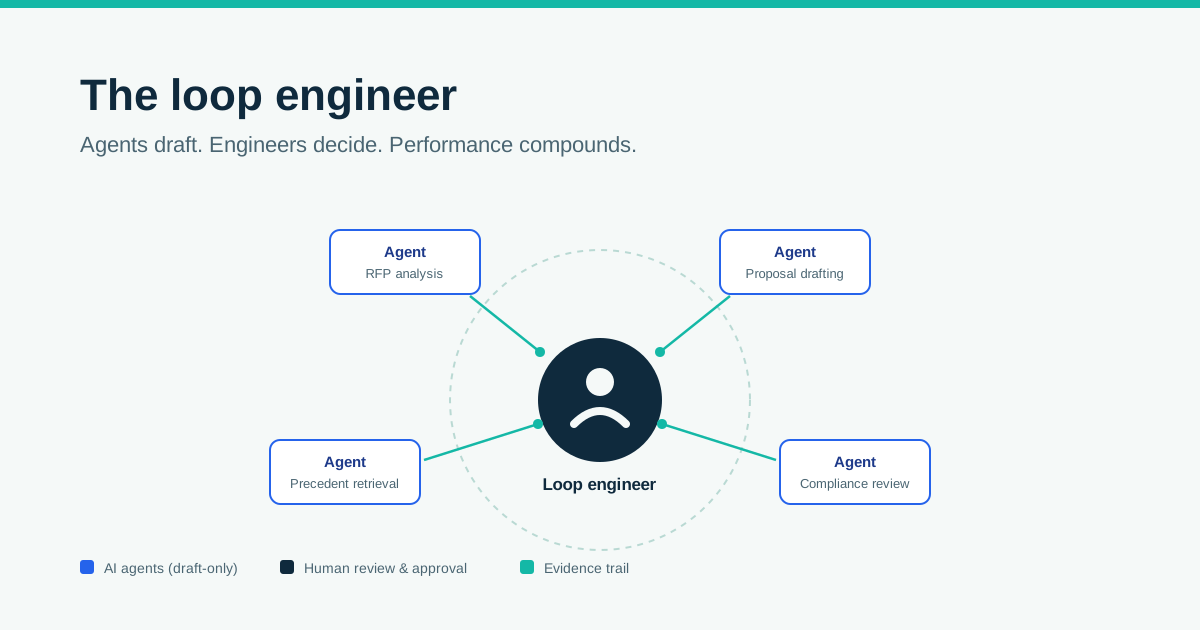
The firms pulling ahead are not the ones that bought the flashiest model. They are the ones that figured out the operating pattern: AI agents do the heavy lifting, and a human, the loop engineer, supervises, verifies, and approves everything before it leaves the building. The model is not the product. The governed loop around it is.
What is a loop engineer?
A loop engineer is a practicing engineer or senior technical staff member who sits inside the AI workflow rather than downstream of it. Their job is not to write prompts all day. It is to:
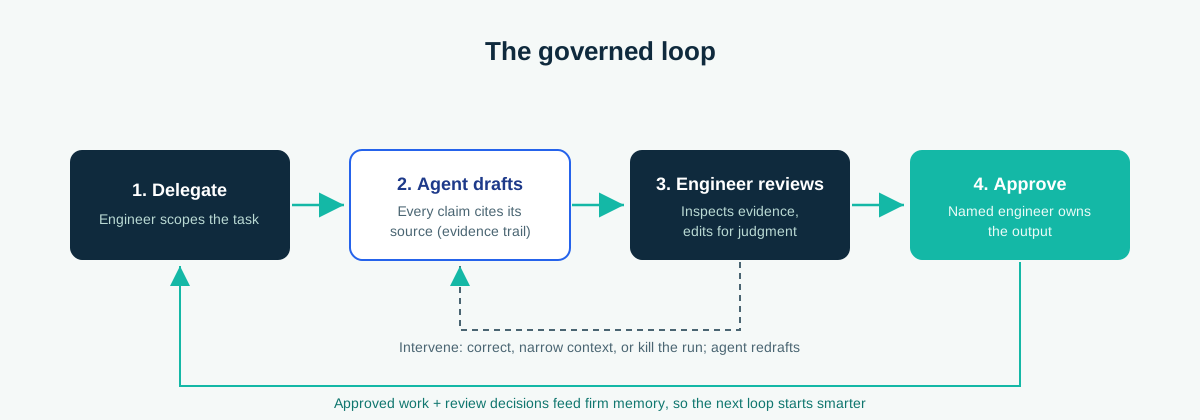
- Delegate well-scoped tasks to AI agents: analyze this RFP, draft this technical approach section, check this submittal against the spec.
- Review evidence, not just outputs. A good agent workflow shows its sources: which past project, which code clause, which page of the RFP a claim came from. The loop engineer inspects that trail.
- Intervene mid-run when an agent drifts: narrowing context, correcting an assumption, or killing the run entirely.
- Approve or reject the final artifact, exactly the way a principal reviews a junior engineer's work before it goes out.
If that sounds like what senior engineers already do with junior staff, that's the point. The loop engineer role formalizes an existing management skill and points it at agents instead of (or alongside) people. The difference is throughput: an agent produces a reviewable draft in minutes, not days, and never gets pulled onto another project.
Why full automation fails in AEC (and why that's fine)
AEC is not a domain where you can let AI run unattended. Proposals carry contractual exposure. Calculations and compliance claims sit under a professional engineer's stamp. Client relationships are won on judgment, not word count.
That reality is precisely why human-in-the-loop is the right architecture rather than a compromise. Research on enterprise deployments is consistent: organizations that invest in real-time monitoring, audit trails, and human-in-the-loop controls dramatically outperform those that don't. The pattern that works is AI drafts, humans decide: automate the 60-70% of work that is repetitive assembly, and keep the 20-30% that requires judgment with a reviewer who verifies every cited source.
For a firm principal, this reframes the AI question. You are not deciding whether to trust a model. You are deciding whether your firm can review AI-drafted work as rigorously as it reviews human-drafted work. Most firms already have that muscle.
Where the loop engineer moves the needle: the pursuit workflow
The clearest early wedge for most civil and geotechnical firms is the pursuit pipeline: RFP analysis through proposal submission. It's high-stakes, deadline-driven, and eats senior staff time that should go to billable work.
Here's what the workflow looks like with a loop engineer running it:
RFP analysis. An agent ingests the RFP and produces a structured breakdown (scope, evaluation criteria, mandatory forms, compliance requirements, red flags), with each item linked back to the page it came from. The loop engineer skims the evidence trail in twenty minutes instead of reading 200 pages line by line, and catches the one buried requirement the agent flagged as ambiguous.
Precedent retrieval. The agent searches the firm's project history for comparable work (similar scope, similar client, similar delivery method) and surfaces the sections of past proposals that scored well. The loop engineer picks which precedents actually apply. This is where firm memory compounds: every reviewed pursuit makes the next retrieval sharper.
Proposal drafting. Agents draft the technical approach, project understanding, and management plan sections from the approved outline. Every factual claim carries a citation to firm knowledge or the RFP itself. The loop engineer edits for judgment and voice, the parts that win work, instead of assembling boilerplate.
Compliance review. A second agent pass checks the near-final proposal against the RFP's mandatory requirements: forms, page limits, certifications, required language. The loop engineer clears each flagged item. Nothing ships on the agent's word alone.
The numbers on this workflow are striking. RFP automation platforms report 30-40% reductions in response time and up to 80% cuts in manual research effort, with teams saving 32+ hours per response. For a mid-size firm responding to 40-60 RFPs a year, that is thousands of senior-engineer hours redirected from document assembly to the work that differentiates the firm, or to going after pursuits it previously had to skip.
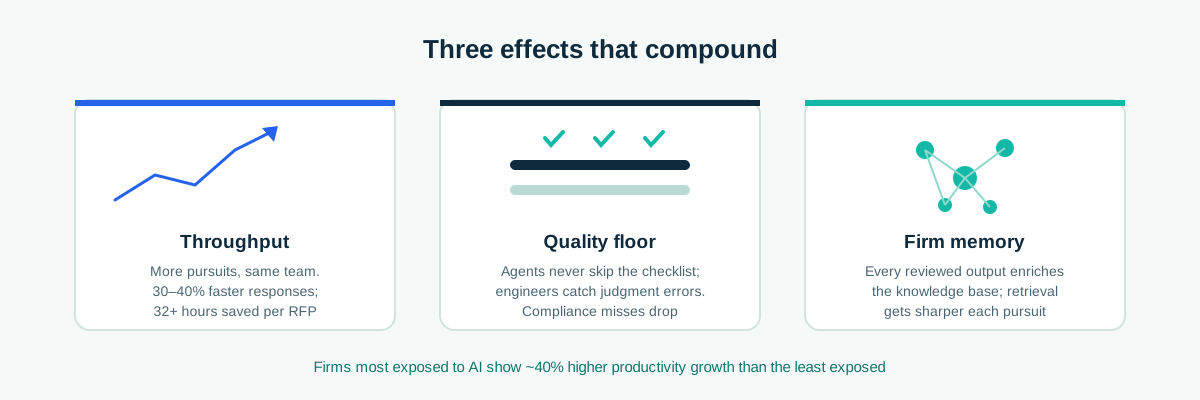
Three effects compound:
Throughput without headcount. The same pursuit team covers more RFPs. Firms most exposed to AI show productivity growth roughly 40% higher than the least exposed. In pursuit work specifically, the bottleneck shifts from drafting capacity to review capacity, which is exactly the capacity your senior people already have.
Quality floor rises. Agents don't forget the compliance matrix at 11pm before a deadline. The loop engineer's review catches judgment errors; the agent's consistency catches process errors. Go/no-go decisions get better too, because RFP analysis that used to take days now happens before the decision meeting.
Firm memory becomes an asset. Every approved output, with its evidence, corrections, and review decisions, feeds back into the knowledge base. The messy shared drive gradually becomes an AI-usable institutional memory. This is the long game: a firm where twenty years of project knowledge is retrievable in seconds, governed by the same review discipline that built it.
How to build the role
You don't need to hire "loop engineers" off the street. You need to designate them and give them the right environment:
- Start with one workflow, not a platform rollout. Pursuit/RFP work is the proven wedge: bounded, measurable, and painful enough that adoption sells itself.
- Pick reviewers, not enthusiasts. The best loop engineers are the people already trusted to review junior work: skeptical, detail-oriented, protective of the firm's name. Their skepticism is a feature; it becomes the quality gate.
- Demand evidence, not eloquence. Whatever tooling you adopt, the non-negotiable is traceability: every claim in an agent's output should link to a source a reviewer can open. If a tool can't show its work, it can't be supervised, and unsupervised AI has no place under your letterhead.
- Keep agents draft-only. Agents propose; humans approve. No agent output reaches a client, a regulator, or a signature without a named engineer accepting responsibility for it. This is what makes the whole system defensible, professionally and legally.
- Measure the loop. Track hours-per-proposal, RFPs pursued per quarter, compliance findings caught in review, and win rate. The loop engineer role pays for itself when senior hours shift visibly from assembly to judgment.
The bottom line
AI will not replace civil engineers. But firms that pair AI agents with engineers who know how to supervise them will outperform firms that do neither: in proposal volume, in turnaround, in consistency, and eventually in the compounding value of their institutional knowledge.
The loop engineer is the highest-leverage new role in AEC precisely because it isn't new at all. It's the review discipline your firm already trusts, aimed at a workforce of agents that never sleeps. The firms that formalize it in 2026 will spend the next decade harvesting the compound interest.
Wukanda is a governed AI work environment for civil engineering firms, where agents draft, engineers decide, and every output carries its evidence. If you want to see what a loop-engineered pursuit workflow looks like on your own RFPs, get in touch.